Query Fan-Out Explained: How It Works and Why It Beats (or Loses to) Content Silos
Too Long; Didn't Read
- Query fan-out: AI systems decompose a single user query into 8–20+ subqueries, researching each in parallel before synthesizing one answer
- Why it matters: Traditional one-keyword-per-page SEO no longer works; AI search rewards content that answers multiple related questions
- Content silos vs. clusters: Silos work for narrow, transactional topics; clusters (pillar + supporting pages) win for broad, multi-faceted subjects and AI visibility
- Structure matters: A hub-and-spoke pillar/cluster architecture with tight internal linking is how you actually capture fan-out traffic
- Measurable now: AEO tools (Profound, Semrush, queryfanout.io) track subqueries and show which of your pages get cited across fanouts
- Bottom line: Teams that win in AI search won't have the most pages — they'll have the deepest, most interconnected content addressing all angles of a topic
What Is Query Fan-Out?
Core Definition
Query fan-out is the active decomposition of a single user query into multiple related subqueries — typically 8 to 20 or more — which are researched in parallel by an AI system before being synthesized into one coherent answer.
At Google I/O 2025, Google’s Elizabeth Reid confirmed that the company uses a custom version of Gemini to break questions into dozens of subtopics, researching each before combining results. This isn’t a backend optimization — it’s a fundamental shift in how search “understands” intent.
The 5-Component Model
Query fan-out operates through five stages:
- Prompt Analysis: The system interprets what the user is really asking
- Subquery Generation: The original question is split into related, narrower questions
- Parallel Execution: Each subquery is researched independently and simultaneously
- Relevance Scoring: Results are evaluated for how well they answer each subquery
- Answer Synthesis: The best information across all subqueries is combined into one response
Real-World Example: “Best Dog Food for Sensitive Stomachs”
To see this in action, we ran the query “best dog food for sensitive stomachs” through queryfanout.io to see how it fans out across ChatGPT, Claude, and Perplexity. The results:
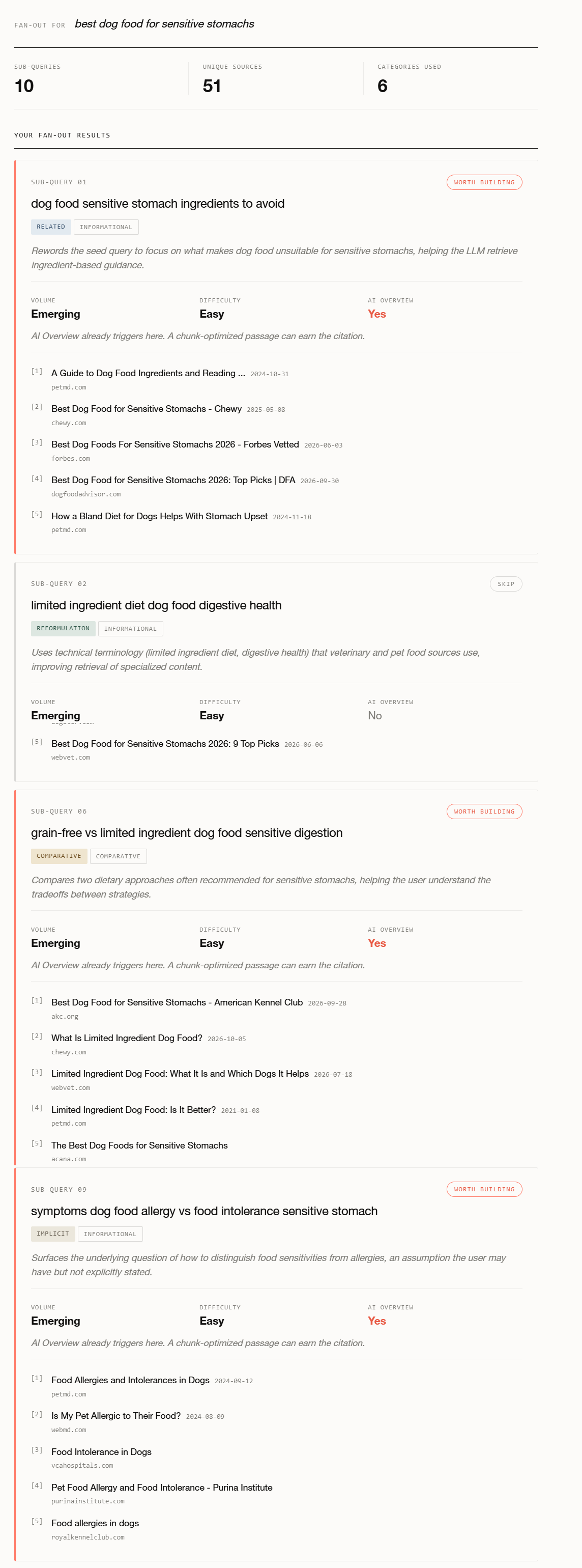
What makes this tool especially useful isn’t just the subquery count — it’s that each sub-query gets classified by transformation type and scored with a content recommendation. Here’s a sample of what that breakdown looks like:
| Sub-Query | Tag | Recommendation |
|---|---|---|
| Dog food ingredients to avoid for sensitive stomachs | Worth Building | |
| Limited ingredient diet dog food for digestive health | Reformulation | Worth Building |
| Grain-free vs. limited ingredient dog food for sensitive digestion | Comparative | Worth Building |
| Symptoms of dog food allergy vs. food intolerance | Implicit | Skip |
Notice how no single page could realistically cover all 6 transformation types and 10 subqueries at the depth each one deserves — this is exactly the gap a pillar + cluster structure is built to close. The “Worth Building vs. Skip” scoring also gives you a built-in prioritization signal: it tells you which subqueries deserve a dedicated cluster page versus which can simply be addressed in a paragraph on an existing page.
Scale varies by system: Google AI Mode typically runs 5–11 subqueries per query, while ChatGPT’s Deep Research mode has been observed running as many as 420 queries for a single complex prompt.
The Evolution of Search Matching
Query fan-out represents the latest stage in how search engines match content to user intent:
| Era | Model | How It Worked |
|---|---|---|
| Traditional SEO | One-to-One | One query matched to one ranking page |
| Modern Keyword SEO | Many-to-One | Multiple keyword variations/synonyms matched to one optimized page |
| AI Search (Today) | One-to-Many | One query spawns many subqueries, pulling from many sources |
Key insight: Optimizing for a single keyword on a single page is no longer sufficient. AI search systems actively hunt for content that answers the surrounding questions too.
Why This Matters for Your Content Strategy
"Creating content without considering query fanouts is like doing SEO without knowing your keywords." Profound
This shift changes four critical aspects of content planning:
- Topical Authority is Now a Ranking Signal: Pages that comprehensively address a subject — not just a single keyword — are more likely to be pulled into AI-generated answers across multiple subqueries.
- Keyword Clustering Replaces Keyword Targeting: Strategy should group semantically related keywords and subtopics into a single, deep resource rather than writing one page per keyword.
- Content Silos Can Become a Liability: Rigid, narrowly-scoped pages that don’t cross-reference related subtopics may be passed over in favor of competitors whose content naturally answers more of the fan-out.
- Google’s Own Guidance Confirms It: Pages that address multiple subqueries related to a topic are more likely to be cited in AI Overviews and AI Mode results.
Query Fan-Out vs. Content Silos: Which Wins?
When Content Silos Still Work
Traditional content silos — tightly organized hierarchies where each page targets one specific keyword and links only within its topic branch — still perform well when:
- The topic is narrow and doesn’t have many adjacent subquestions
- User intent is highly specific and transactional (e.g., a single product spec page)
- The goal is traditional ranking for a well-defined keyword, not AI citation
When Query Fan-Out–Optimized Content Wins
Content built around the fan-out model — often structured as topic clusters with a strong pillar page and well-linked supporting content — outperforms silos when:
- The topic is broad or has many natural follow-up questions (how-to guides, comparisons, ultimate guides)
- You want visibility in AI Overviews, AI Mode, or chatbot-generated answers
- The buyer journey includes multiple related questions before a decision is made
- Competitors are already being cited across multiple subqueries you aren’t addressing
The Decision Matrix
| Factor | Favors Silos | Favors Fan-Out Clusters |
|---|---|---|
| Topic Breadth | Narrow, single-intent | Broad, multi-faceted |
| Search Surface | Traditional blue-link SERP | AI Overviews / AI Mode / chat assistants |
| Content Depth Needed | Single answer suffices | Multiple angles expected |
| Internal Linking | Isolated by design | Deep cross-linking required |
| Competitive Landscape | Low subquery competition | Competitors covering adjacent subtopics |
Bottom line: Pure content silos aren’t dead, but they’re increasingly the exception rather than the rule. Most topics worth ranking for today have enough adjacent subqueries that a clustered, interlinked approach will outperform an isolated page — especially for AI-driven discovery.
How to Structure Pillar + Cluster Content for Query Fan-Out Optimization
Knowing that query fan-out exists is one thing. Building a content architecture that wins at it is another. Here’s the practical framework, informed by current guidance from Semrush, Search Engine Land, and Google AI Mode itself.
1. Map Intent Clusters, Not Just Keywords
- Anticipate sub-queries: AI models deconstruct a single prompt into multiple simultaneous sub-questions — comparisons, pricing, definitions, use-cases, and next steps. Run sample prompts through AI platforms to see what related angles or follow-up questions are triggered, as we did with the dog food example above.
- Model the fan-out paths: Group the triggered subqueries into distinct intent clusters rather than tracking static keyword lists. Using the queryfanout.io data above, “ingredient concerns,” “diet-type comparisons,” and “symptom diagnosis” would each become their own intent cluster.
- Tie to revenue first: Start with a single core cluster closely tied to your product or service rather than trying to overhaul your entire site at once.
2. Build a Dual-Layer Architecture (Hub and Spokes)
Pillar Page
Acts as a comprehensive, broad overview of the core topic. It establishes your primary topical authority and links out to every supporting cluster page.
Cluster Pages
Dive deep into specific subtopics, niche questions, or individual fan-out sub-queries — e.g., specific comparisons, step-by-step guides, or ingredient breakdowns.
Consolidate vs. split: Traditional SEO often gave every single keyword its own page. AI search benefits when individual pages consolidate related sub-questions, so the engine has rich, multi-faceted passages to extract and cite — rather than fragments spread thin across dozens of near-duplicate pages.
3. Write in Extractable “Answer Blocks”
- Use the inverted pyramid: Place a direct, concise definition or answer immediately under every major header (H2/H3) rather than burying the lead.
- Preempt “People Also Ask”: Format subheadings as the exact implicit and explicit questions users — and AI sub-query routers — ask.
- Keep chunks modular: Write self-contained paragraphs, bulleted lists, and structured tables that AI retrieval systems can easily parse and synthesize without losing context.
H3 Is grain-free dog food better for sensitive stomachs?
→ Answer in first sentence: "Not always — grain-free isn't inherently gentler on digestion; limited-ingredient formulas tend to matter more."
4. Wire a Tight Internal Linking Network
- Dual-direction linking: Cluster pages link back to the central pillar page, the pillar links down to each cluster, and relevant cluster spokes interlink with one another using descriptive anchor text.
- Connect to conversion points: Link supporting spoke pages directly to relevant product or service pages so AI citations and user traffic translate into assisted conversions.
- Prune underperformers: Audit your cluster quarterly. If a spoke page earns no AI citations or clicks after multiple refresh cycles — i.e., it was marked “Skip” in your fan-out analysis, or underperforms despite a “Worth Building” tag — merge it back into its parent pillar rather than leaving it to rot as a thin, isolated page.
Tying it together: The "Worth Building" vs. "Skip" scoring from tools like queryfanout.io maps directly onto this framework — "Worth Building" subqueries become dedicated cluster pages (the spokes), while "Skip" subqueries get folded into the pillar page as a paragraph or FAQ entry instead of becoming their own thin page.
How to Measure Query Fan-Out Performance
Query fan-out is no longer a black box. AEO (Answer Engine Optimization) platforms like Profound, Semrush, and queryfanout.io now surface:
- Word transformations between the original query and generated subqueries
- A breakdown of every subquery variation triggered, tagged by type (Related, Reformulation, Comparative, Implicit)
- How many fanouts occurred per AI execution, and which of your pages were pulled in
- A “Worth Building vs. Skip” recommendation per subquery to guide content prioritization
This turns query fan-out from an abstract concept into a measurable, auditable part of your content strategy.
Practical Audit Checklist
- Does this page address the 5–10 most obvious follow-up questions a reader would have?
- Are related subtopics covered on this page, or siloed off on disconnected pages with no internal links?
- Would an AI system pulling subqueries from this topic find enough depth here to cite it multiple times?
- Is there a clear pillar page with supporting cluster content, or is this topic fragmented across isolated posts?
- Have we run this topic through a fan-out tool to identify “Worth Building” vs. “Skip” subqueries?
- Are we tracking subquery coverage using an AEO tool, or only tracking single-keyword rankings?
Conclusion
Query fan-out is quietly rewriting the rules of search visibility. The sites getting cited in AI Overviews and AI Mode aren’t the ones ranking #1 for a single keyword — they’re the ones whose content naturally answers the full web of related questions a user (or an AI) might ask next.
Content silos aren’t obsolete, but they need to be chosen deliberately, not by default. For most strategic topics, a clustered pillar-and-spoke architecture built around topical authority and deliberate keyword clustering will outperform the narrow, single-intent pages of traditional SEO.
The teams that win in AI search won’t be the ones with the most pages — they’ll be the ones whose content answers the most questions behind the question.